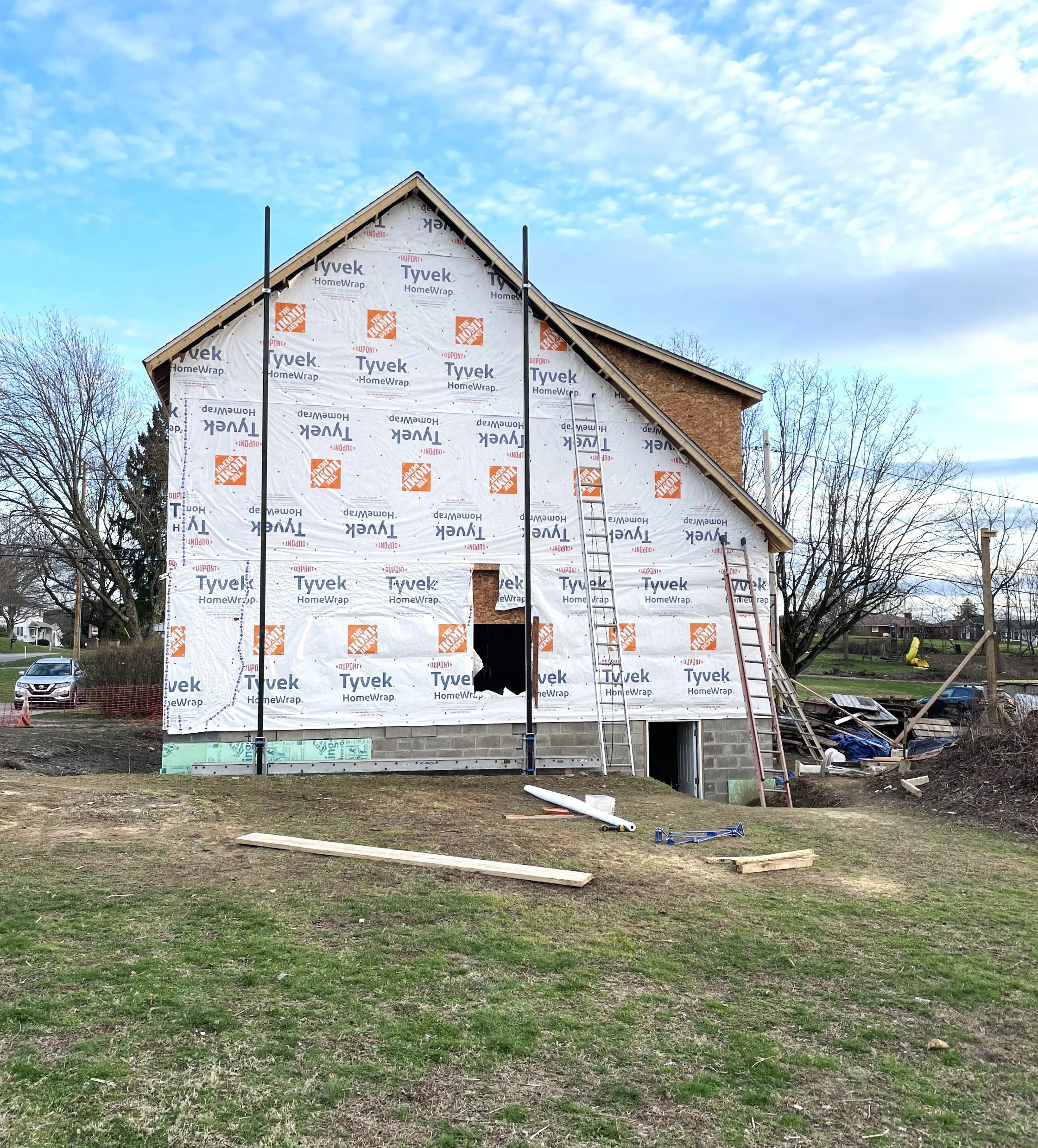
A Saltbox Home
We bought the “bowling ball” house, hoping to be able to save parts of it. We rebuilt the foundation while keeping the home supported in the air above it, but at some point, our desire to save parts of it proved to be impossible to achieve and we slowly tore the whole house structure down (leaving the new foundation). The house sat vacant for at least 15 years, but depending on who you asked, it had been vacant their “whole lifetime!” Knotweed penetrated the foundation while poison ivy twisted its way into the walls and water soaked the front of the house, inside and out, over and over again, until some of the 2×4s “supporting” the walls could literally crumble in your hand. So … you know. Not really worth saving. Not really even possible.
So, we looked at this house, thinking it was probably a cute one story Cape Cod, potentially with dormers that over time had lost its battle to poor American build-on renovations - because, who doesn’t need a bigger home? We discussed building the Cape Cod style again, but that would allow for 1 bed and 2 baths. Although we personally don’t think people need 2000+ square feet homes, we do realize that most do want at least 1.5 baths - 2 and usually 3 bedrooms is the minimum, as decent kitchen, and potentially an area to “work from home”. So, we set out to capture something from the original feel and also give the people what they (might) want. Enter the Saltbox.
The Saltbox style became popular in America in the 1600s in New England and some can still be seen today. It is a style named after a saltbox - a lovely little item that hung in kitchens and held salt. It had a sloped lid which is a similar look to the Saltbox house catslide roof line. A true saltbox is not a full 2 stories, but rather 1.5 stories. As I was reading about saltbox house styles, it is said that building on a single story addition helped to keep property taxes down, way back in the 1600s, when Americans paid the Queen their taxes. But, it was also a practical way to add a little more space to homes that needed or wanted a larger living area on the first floor. We took this idea and ran it down the side gables of the house, but added a shed dormer out the back, which allowed for a full master suite.
Over there in New England, they use(d) wood clapboard siding. We plan to use LP lap smartside and add some little details here and there to give it the colonial feel of one of those lovely New England homes.
https://www.thespruce.com/what-is-a-saltbox-house-5120475; https://thecraftsmanblog.com/what-is-a-saltbox-house/